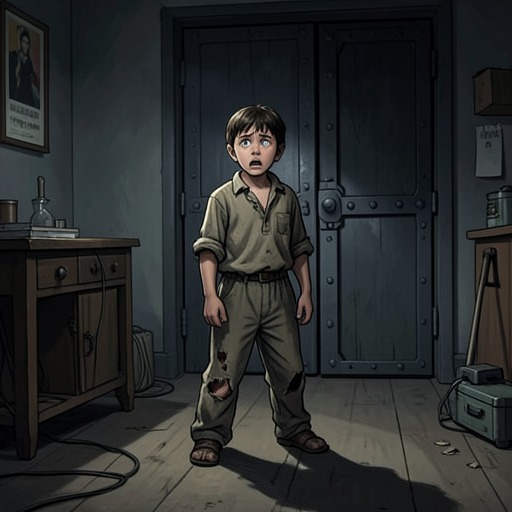
The Death of Saul and Destruction of the Fe Collar
Bride of AlvarThe Death of Saul and Destruction of the Fe Collar is the climactic defeat of Saul and the destruction of the device that has enslaved Alvar. The event brings the story’s central struggle over freedom, responsibility, love, and bodily control to a violent resolution: Saul uses the collar’s key to command Alvar, Lucy Hammond refuses to abandon him, and her blood enables the weapon of oppression to be broken. Saul is consumed by Alvar’s fire, while Alvar returns from his Cursed form only after the collar melts away.
Causes and Background
The confrontation is rooted in Saul’s earlier seizure of Alvar’s will. When Saul first activates the Fe collar, Alvar experiences a burning sensation despite his immunity to ordinary flames. He has transformed from man to Cursed and back again, and the collar makes him a slave to Saul’s will. Alvar’s panic gives way to icy terror because the danger is not merely physical transformation: his body and actions no longer belong to him. Saul treats the device as an experiment, claiming that he only wanted to see how it worked, while Ysta identifies herself as the maker awaiting payment.
That enslavement explains the moral wound surrounding Alvar’s past. Saul forced him to perform acts he would never have chosen, including sexual acts, and Alvar erased some of the memories from the Mystar so that he would not have to see them again. He retained other memories as self-punishment, preserving them as evidence of his naivety and as a warning against intimacy. His later confession makes the distinction between voluntary wrongdoing and compelled action explicit: Alvar was the instrument of Saul’s violence, but Saul controlled the instrument.
Saul’s rule has already demonstrated what the collar can make possible. In one village, Alvar is left with the taste of innocent blood in his mouth after every man but one has been killed. Saul uses the survivor to spread terror, ordering him to tell other villages that submission will spare their lives. Burning homes and bodies fill the streets, turning the collar from a private instrument of domination into a technology of public tyranny. Alvar’s own history also includes an earlier forced transformation in which he dives into a pyre to retrieve his mother’s corpse while villagers reject him as a pretender and threaten him with weapons. His monstrous form is therefore repeatedly shown as something Saul and frightened communities interpret as proof of evil, even when Alvar’s actions arise from coercion, grief, or protection.
What Happens
Saul’s game begins with Alvar under his control while Lucy is captive and bound. Lucy decides to behave as though she does not understand what is happening. She kisses Alvar, treating him as her husband and using the moment to preserve their bond while she believes death may be imminent. Alvar’s eyes expose a resistance hidden beneath the illusion Saul is creating through him; Lucy silently communicates that she knows the man inside the commanded body is still present.
Saul watches from the darkest corner of the room. Through the key, he orders Alvar to hurt Lucy and attempts to overwrite Alvar’s love with humiliation. Alvar’s voice becomes wooden and robotic as he repeats the words Saul imposes on him, but he resists when Saul demands that he declare Lucy disgusting and deny loving her. Alvar removes Lucy’s wrist bindings and embraces her protectively before his body begins to harden and contort. Saul then holds the key toward him and commands him to obey. Alvar shakes violently, releases Lucy, falls to the floor, and writhes in pain as the spell forces his body between human and Cursed forms.
Lucy turns Saul’s control into an opening. When Saul pulls her hair, she yanks herself away and grabs the key from his hand. She uses her body weight to break the chain holding it around his neck. A shard of glass lies on the floor from Alvar’s transformation, and Lucy recalls from Alvar’s memories that blood was exchanged to bind the key and collar. She cuts her palm deeply, from the hand toward the wrist, and covers the key with her blood. The act is both a desperate physical sacrifice and a direct attempt to alter the terms of Saul’s magical authority.
Lucy then commands Alvar to fill the room with fire. Saul has only a moment to stare at her in disbelief before Alvar’s flames engulf him. The fire destroys what remains of Alvar’s bedroom, burns through the ropes around Lucy’s ankles, and consumes Saul amid his cries. Lucy reaches Alvar’s monstrous body and wraps her arms around his thick neck. With her blood still pouring from the wound, she forces the stolen key into the lock of the Fe collar and turns it.
The collar’s destruction marks the event’s second decisive blow. Alvar groans so deeply that the sound shakes the room; the collar falls to the ground and melts into a pool of blood-like substance. The flames vanish, and Alvar’s Cursed form folds back into that of a man. The physical reversal confirms that Saul’s command has been broken rather than merely interrupted. Yet liberation does not leave the couple unharmed: Alvar shudders and collapses, while Lucy, weakened by the depth of her self-inflicted wound and the loss of blood, collapses beside him.
Consequences and Aftermath
Saul’s death removes the immediate wielder of the Fe collar, but the destruction of the collar is equally important because it eliminates the device through which his authority reaches Alvar. Defeating Saul without destroying the collar would leave the structure of coercion available to another controller. By melting it, the scene closes the physical channel between command and compelled action and makes Alvar’s return to human form permanent within the event’s immediate logic.
The victory also changes the meaning of Alvar’s violence. He has killed and injured under Saul’s control, and he carries shame for what he was forced to do. The scene does not erase those consequences; instead, it dramatizes the difference between the enslaved body and the enslaver’s intention. Alvar struggles against Saul’s orders, protects Lucy whenever control loosens, and finally directs his fire against Saul only within the opening Lucy creates. Responsibility remains morally complicated, but Saul is exposed as the agent who converts Alvar’s Curse into an instrument of death-dealing.
Lucy’s role transforms the rescue from a simple defeat by superior power into an act of informed solidarity. She recognizes that Alvar’s resistance is still present, retrieves the key, remembers the blood-binding mechanism, and risks her life to break it. Her action answers Alvar’s fear that he is too distorted to be loved with conduct rather than reassurance: she chooses him while his body is being used against her and makes his freedom the immediate objective of the scene.
Narrative Significance
The event completes a reversal that has been prepared through Alvar’s public confession. He identifies himself as the monster Saul used to enslave the people, explains that his family rejected him for carrying the Curse, and reveals that Saul placed the Fe collar on him because he saw a controllable means to power. The final confrontation turns that confession into action. Alvar is no longer only the hidden source of past atrocities or the ashamed survivor who fears that coercion has permanently contaminated him; he becomes a person whose captivity is visibly broken.
The scene also rejects the false alternatives that have governed Lucy’s relationships. Mike Jones represents the stable future Lucy once imagined as an escape from her mother’s lies and the instability of childhood, but she realizes that she wants him as a friend rather than a lover. Alvar offers neither a simple safe arrangement nor an uncomplicated romance: he initially describes marriage as a business arrangement and fears that his history makes him unworthy of love. The rescue gives their relationship its most concrete test. Lucy’s choice is made under fire, amid coercion and bodily danger, not in the comfort of an abstract promise.
As an event, the destruction of the Fe collar is therefore both a battle and an ethical recognition. Saul’s commands reveal that domination depends on making another person’s body appear to speak for itself. Lucy reads the difference between the commanded voice and Alvar’s resistance, then acts on that distinction. The value shift is from apparent helplessness to freedom, but it is not clean or costless: Saul dies, the collar is destroyed, Alvar is restored to human form, and Lucy nearly bleeds to death beside him. The ending preserves the price of liberation while making clear that the instrument of enslavement, and not merely its current master, has finally been removed.